Kalabukhov House
The Heart of a DogKalabukhov House is the Moscow apartment building where private domestic life repeatedly collides with public authority. Its seven-room apartment, shared stairways, and housing committee make the building more than a setting: they are the material ground on which disputes over space, property, registration, and political power take effect.
The Building and Its Domestic Order
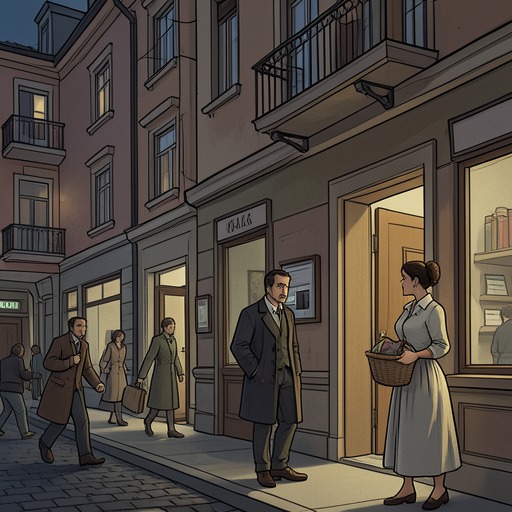
The building’s common areas preserve a visible record of changing conditions. Recalling his residence there since 1903, Professor Preobrazhensky contrasts the earlier order of the entrance with the disorder that followed March 1917: the galoshes rack disappeared, along with property including walking sticks, an overcoat, and the porter’s samovar. The carpet was removed from the front staircase, and the main entrance was boarded up, forcing residents and visitors to use the back entrance. The professor also complains that the staircase is dirtied by footwear and that flowers have been taken from the landing.
These details make the building’s deterioration concrete. The lost rack and carpet, altered entrance, and need to protect galoshes under lock and key show how political upheaval is experienced through ordinary routines and shared property. For the professor, the changes are not abstract: they disrupt the working and domestic environment of the apartment and the order of the building itself.
Housing Rules and the Committee
The building’s new house committee brings its own authority into the professor’s home. Its representatives say they have been charged with increasing occupancy, although the professor cites the August 12 regulation exempting his apartment from such an increase. The committee nevertheless argues that he occupies too much space because he lives alone in seven rooms.
The professor answers that the rooms serve distinct functions: the waiting room also serves as library, dining room, and study; the apartment additionally contains a consulting room, operating theatre, bedroom, and servant’s room. The committee’s demand goes beyond adding tenants: it asks him to surrender the dining room voluntarily as a matter of labour discipline, and then presses him to give up the consulting room as well. The dispute sets the committee’s collective judgment about space against the professor’s account of how his home supports both work and residence.
Sharikov’s Claims to Residence
The building’s rules and paperwork later provide a route for Sharikov to assert a place within it. When the question of naming him arises, Shvonder proposes a certificate identifying him as Poligraph Poligraphovich Sharikov and describing him as born in the flat. That proposed wording turns the apartment into an administrative point of origin for someone whose identity is otherwise contested.
Sharikov subsequently presents three pieces of paper—green, yellow, and white—and declares that he belongs to the residential association. He claims that the tenant in charge of flat No. 5, Preobrazhensky, must provide him with his entitlement of thirty-seven square feet. The demand converts a committee-backed claim into a concrete challenge to the professor’s control of his own dwelling.
From Housing Authority to Political Conflict
The building’s institutional network also gives Sharikov access to public authority beyond residence. Shvonder helps him obtain a post in the Moscow Cleansing Department, responsible for eliminating vagrant quadrupeds. Sharikov’s appointment shows how support from the house committee can translate into an official position, extending the conflict from the allocation of rooms to the exercise of administrative power.
That alliance returns to the building in the form of a written accusation. Sharikov, identified as a sub-department controller, signs a report alleging that Preobrazhensky threatens Shvonder, keeps a firearm, makes counter-revolutionary speeches, and has ordered Zinaida Bunina to burn Engels; Shvonder countersigns it as chairman of the house committee. The document turns a private and institutional feud into an accusation with potential legal consequences.
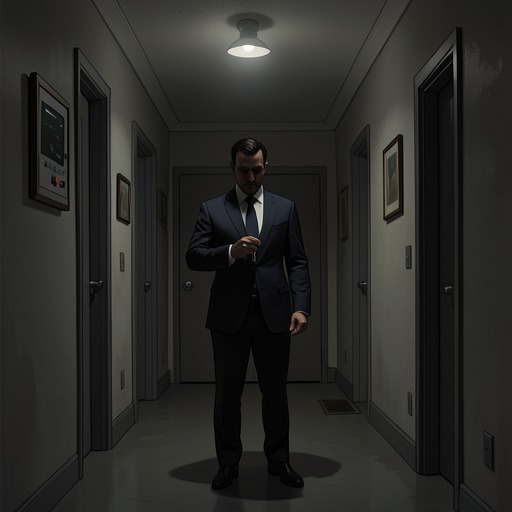
The conflict culminates in a nocturnal visit by officials bearing a warrant to search the apartment and, depending on the results, arrest its occupants. They name Preobrazhensky, Bormenthal, Zinaida Bunina, and Darya Ivanova as charged with Sharikov’s murder. The building’s domestic interior has become the site where housing disputes, political allegations, and criminal procedure converge. Kalabukhov House thus gives the story’s competing claims to space and authority a tangible address: decisions made in committees and on paper reach directly into the rooms and lives of its residents.